

1st Great War – The War of the Fang
第一場大戰 - 獸牙戰爭
Time: Around 3,000 years ago
Main Threat: Beastman Warlord Ka'Roth the Apex
Philosophy: Only the strong deserve to rule.
Summary:
-
Ka'Roth, a Beastman conqueror, believed the world should be ruled by the strongest, physically and magically.
-
He united the beastmen under his rule and waged war across continents.
-
Elves, humans, and Halflings/Dwarves formed a coalition to fight back.
-
Ka'Roth was slain in single combat, but the scars of his war shaped early politics and race relations for centuries.

2nd Great War – The Demonlord’s Peace (The Scorching War)
第二場大戰 - 魔王的和平 (焚世之戰)
Time: Around 2,000 years ago
Main Threat: The Demon Lord Lilratha
Philosophy: True peace is unity under my rule.
Summary:
-
Lilratha offered peace, but only through control. Her dominion would mean all races serving under her, masked as harmony.
-
She was unmatched in magical power and nearly achieved global dominance.
-
In desperation, the world’s races agreed to burn the Tree of Mana to weaken her.
-
It worked; but at the cost of shortening elve's lifespans and severing the world’s connection to the gods, as the elves believe.
-
During this war, the legendary giant warrior Thalos played a pivotal role, wielding his Great Sword Sky Breaker to turn the tide of battle. After the conflict, he plunged his sword into Valor Spring as a symbol of peace.
-
The term "Mozu" was used by the Giants to classify any being that didn’t resemble humans or had horns. It is still used today, although some find it offensive due to its broad, categorizing nature.
-
The nation of Amarath was founded during this war, uniting several factions under a modern ideal of morality and strength.
-
Some Elves, refusing to accept the burning of the Tree of Mana and the founding of Amarath, abandoned Enhnore and established the hidden realm of Sylvenor.
-
Some Tieflings refused the Demon Lord’s cause and were eventually accepted in Amarath, though tensions lingered for years.
-
Tensions with the Tieflings ran deep, fueled by the fact that the Demon Lord herself was one of their own, but these fears were gradually overcome over time.
-
The Goblins of Auris sided with the Demon Lord, earning distrust from the Drakeling of Tiris, the two kingdoms have reconciled only in recent years.
-
After the Demon Lord’s defeat, those the Giants labeled as Mozu; Lamia-like, Slime, or Spider folk, fled southeast to found Miradia, a refuge where they could live free from fear and judgment.
-
While the Orcs formed an Alliance with the Demon Lord, they were never loyal to her and fought just for the thrill of battle.

3rd Great War – The Blood War
第三場大戰 - 血族戰爭
Time: Around 500 years ago
Main Threat: Valrico the Crimson, a former human turned vampire
Philosophy: We are not monsters, we are the future.
Summary:
-
Turned by Dracula, Valrico saw vampires as the next evolution of mankind.
-
Dracula was slain early, but Valrico carried on, creating legions of vampires and trying to build a kingdom of immortals.
-
The war spread panic across nations as turning spread uncontrollably.
-
The Mythic Unity Foundation was established during the Third War to regulate magic, enforce laws, and maintain peace among the warring factions.
-
After Valrico’s defeat, strict international vampire laws were established, banning unauthorized turning and enforcing population control, with turning allowed only by Great Elders under severe penalties.
-
Hybrids, which are vampire-human offspring, are encouraged because they age and die, helping control vampire numbers.
-
Some Dwarves fled Boldohr and sought refuge on the central island; welcomed by the Dryads, they settled peacefully, renaming themselves Duergar to mark a new path, separate from their kin.

4th Great War – The Iron Divide
第四場大戰 - 鋼鐵分裂
Time: Around 300 years ago
Main Conflict: Industrialization vs. Nature
Dispute: Progress, but at what cost?
Summary:
-
Though the Duergars had mined their mountains for generations, it was the human Edric Blackvein who transformed their craft into industry, an expansion that ignited the Iron Divide.
-
The Duergars of Varethis and the Dryads of Phuipuvia clashed fiercely over their opposing views on nature and industrialization.
-
Tensions nearly sparked another continent-wide war. Amarath intervened, resulting in the creation of Neutralis and the formal separation of Varethis and Phuipuvia.
-
The Unified Council Alliance was formed in the aftermath of the 4th Great War, as nations realized that unchecked ambition and industrial conflict could end the world faster than any magic ever could.
-
This era marked the rise of Hearton Corp, which began as a railway company before expanding into automobiles and other technologies.
-
Blackvein Industries, founded by the human Edric Blackvein, continues to operate today, its leadership now in Duergar hands, a lasting pillar of Varethis' industrial society.
-
Some Dryads sought refuge in Sylvenor and were granted "permission" to settle in the Savana Rainforest, drawn by their shared respect for nature.

Ka'Roth the Apex
萬獸之巔卡洛斯
A Beastkin conqueror and the leader of the War of the Fang. Believing that only the strong deserved to rule, Ka’Roth united countless Beastkin tribes beneath a single banner and launched a campaign of expansion across multiple continents of Amarath.
Ka'Roth possessed no grand magical power or supernatural influence. His strength lay in his raw power, ability to command armies, inspire loyalty, and impose his will upon those around him. At the height of his power, many feared that the world itself would eventually fall under his rule.
Though slain before achieving his ambitions, Ka'Roth remains one of history's most infamous conquerors and the first great threat to unite the world's races against a common enemy.

Lilratha, the Demon Lord
魔王,莉爾拉薩
The leader of the Second Great War and one of the most influential figures in world history. Lilratha envisioned a world free from conflict, division, and disorder, united beneath a single authority. Unlike many conquerors, she did not promise endless war or domination for its own sake, but peace through unity.
Renowned for her intelligence, charisma, and immense magical power, Lilratha attracted followers from every corner of the world. Many who met her described a ruler who was calm, thoughtful, and surprisingly approachable. She listened to concerns, rewarded loyalty, and often treated both allies and subjects with dignity and respect.
Yet beneath that image was a ruler capable of extraordinary ruthlessness. Lilratha believed that lasting peace could only exist through complete unity, and that opposition itself was a threat to harmony. Critics often described her as an elegant tyrant, noting that while she spoke of cooperation and understanding, her vision ultimately required the world to accept her authority.
Some records even suggest that Lilratha struggled to understand why others fought against her at all. In her view, she was offering the very thing every nation claimed to desire: peace, stability, and unity. Her critics argued that such peace came at the cost of freedom, while her followers believed the sacrifice was worthwhile.
Among her allies were the Orcs, who respected her immense strength and entered into an alliance with her forces. However, historians generally agree that the relationship was built on mutual convenience rather than loyalty. While Lilratha accepted their support during the war, several accounts suggest she viewed the Orcs as a temporary necessity and intended either to bring them into complete submission or to eliminate them once her victory was secured.
The desperation to stop her ultimately led to the destruction of the Tree of Mana. Though Lilratha was eventually defeated, the consequences of her war continue to shape the world more than two thousand years later.
For some, her influence extended even further, inspiring a devoted cult that regards her as a deity to this day.

The Burning of the Tree of Mana
瑪娜之樹的焚毀
During the final stages of the Second Great War, the world’s nations made the controversial decision to destroy the Tree of Mana in an effort to weaken the Demon Lord Lilratha. The decision remains one of the most debated events in recorded history.
Many Elves opposed the plan, believing the Tree to be sacred and deeply connected to both magic and the gods. Following the war, magical ability became more difficult to master, and Elven lifespans were significantly reduced. To this day, many Elves view the event as the moment the world lost its connection to the divine.
However, not all historians agree on what truly occurred. Given the immense size of the Tree, some scholars argue that it was never completely destroyed. Others suggest that poison, magical corruption, or other methods may have been responsible for its decline, with the famous “burning” representing only a portion of the event. After two thousand years, much of the truth remains unknown.
While some regard the loss of the Tree as a tragedy, others argue that the weakening of magic prevented future wars from reaching the catastrophic scale of the Second Great War. As a result, the Burning of the Tree remains one of the most divisive events in world history.
One frequently cited source is High Matron Lucilla, who is believed to have personally witnessed the events surrounding the Tree. Unfortunately for historians, centuries of repeated questioning have produced a collection of testimonies that range from inconsistent to openly contradictory. As a result, while her accounts remain historically significant, very few scholars consider them entirely reliable.

The Founding of Amarath
阿瑪拉斯的崛起
Amarath was founded during the Second Great War as various kingdoms, tribes, and factions united against the growing threat of the Demon Lord Lilratha. Rather than forming around a single race, religion, or bloodline, Amarath was built upon the ideals of morality, cooperation, and strength through unity.
Following the war, Amarath accepted many displaced people, including Tieflings who had rejected the Demon Lord’s cause, Duskari Elves, and more. Over the centuries, the nation expanded, eventually becoming one of the world's most influential powers.
As Amarath grew, immigration and citizenship policies became increasingly regulated. While individuals from all backgrounds may apply, citizenship often requires years of residency, integration, and demonstration of commitment to Amarathan laws and values.
-
The Amaran Ideal
One of the founding principles of Amarath is the belief that a person’s character and actions matter more than their race, origin, or bloodline. This philosophy emerged during the Second Great War, when individuals from many backgrounds united against a common threat.
While the nation has not always lived up to its ideals, the Amaran Ideal remains central to its identity and is often cited as the foundation of its multicultural society.
-
The Fellits of Amarath
The Fellits are frequently cited as one of the greatest beneficiaries of Amarath’s founding. Historically, in small communities of Nimblehill, many historians believe their populations would have struggled to survive without the stability and protection provided by Amarath.
As a result, Fellits are often among the strongest supporters of Amarath’s unity and ideals. Though known for their friendly, community-oriented culture, modern Fellit society has also developed a notable enthusiasm for firearms and marksmanship.
-
The Integration of the Tieflings
Following the Second Great War, many Tieflings who rejected the Demon Lord's cause sought refuge within the newly founded Amarath. Although officially welcomed, they faced widespread suspicion and discrimination because Lilratha herself was a Tiefling.
Over time, Amarath's commitment to its founding ideals gradually improved relations between Tieflings and other peoples. While prejudice did not disappear overnight, the successful integration of the Tieflings is often regarded as one of the earliest tests of the Amaran Ideal.
-
The Elven Departure
Not all Elves supported the founding of Amarath. Following the burning of the Tree of Mana, many opposed the growing emphasis on racial unity, particularly the acceptance of Tieflings, Duskari Elves, and other peoples associated with the war.
Rather than remain, many Elves left Enhnore and established the hidden realm of Sylvenor. The event remains one of the greatest divisions in Elven history.
-
The Cyclopes of Dustfall
Many Cyclopes fought for the Demon Lord during the Second Great War, and their immense size and strength made them among the most feared warriors in the conflict. However, many humans and members of other races also sided with the Demon Lord, making the issue far more complicated than race alone would suggest.
Following the war, Amarath chose integration rather than collective punishment. Over time, the large and more aggressive Cyclopean bloodlines largely disappeared, leaving the more humanlike Cyclopes that are common in Dustfall today.
-
The Centaurs of Wheatmere
After the Second Great War, some Centaurs stayed in Amarath instead of returning to Varkathis. They settled in Wheatmere, shaped its farming economy, and embraced Amarath’s vision of unity.
Over time, Centaur communities became part of Amaran society but maintained ties to their Varkathian roots. Their passion for running led to organized races, which eventually became popular gambling and entertainment events. However, Freehoof Centaurs in Varkathis criticized these races as dishonoring their heritage.
-
The Harpies of Luminara
Many Harpies chose to settle along Amarath's eastern coast. Drawn by the mild climate, open shoreline, opportunities for fishing, and the constant flow of people and cultures passing through its ports, these Harpies gradually formed communities throughout the region.
Early settlers largely left them alone. The Harpies fished, came and went as they pleased, caused few problems, and even provided delivery services between coastal settlements. Over time, what began as scattered coastal communities grew into permanent settlements, eventually becoming an established part of Luminara and Amaran society.
-
The Amarath Sectors
As Amarath expanded following the Second Great War, its growing population and territory became increasingly difficult to govern as a single, unified state. To maintain order while preserving local autonomy, the nation adopted the Sector System.
Under this arrangement, regions such as Solara, Enhnore, Chillis, and Dustfall became sectors of Amarath, each governed locally while remaining subject to oversight from the central government in Drevinton. The system remains the foundation of Amarath's administration today.
-
Immigration policies
As Amarath grew, immigration and citizenship policies became increasingly regulated. While individuals from all backgrounds may apply, citizenship often requires years of residency, integration, and demonstration of commitment to Amarath laws and values.
Amarath maintains strict standards for citizenship. Individuals who abuse these privileges, threaten public safety, or commit serious offenses may be deported or stripped of their status.

Hearton Corp
哈頓企業
Founded following the Fourth Great War, Hearton Corp began as a railway company during a period of growing international trade and economic expansion. By constructing railways across Amarath and neighboring nations, the company helped make travel and commerce faster, safer, and more accessible, becoming one of the driving forces behind modern transportation.
Over time, Hearton Corp expanded into automobiles, energy production, manufacturing, and advanced research. Its innovations contributed significantly to industrial growth and modernization, transforming the company into one of the world’s largest corporations.
In recent years, Hearton Corp has become particularly known for its advancements in GPS, artificial intelligence, autonomous, and advanced machines. Its products and infrastructure are used in many parts of the world, giving the corporation an influence rarely matched by private enterprises. While widely praised as a symbol of innovation and progress, its immense economic and technological reach has also made it one of the most closely watched organizations in modern history.

Mozu Term Origin
魔族稱呼的起源
Mozu is a broad term originally coined by the Giants during the Second Great War to describe races that differed significantly from humans in appearance or biology. The classification included Tieflings, non-bipedal peoples, and many other races that did not fit within the world’s more common populations.
Over time, the term became moderately adopted throughout the world and remains widely recognized today. However, most races classified as Mozu rarely identify themselves by the label, preferring to refer to their own race, culture, or nation instead.
The term remains controversial. Critics argue that Mozu groups dozens of distinct peoples, cultures, and civilizations under a single category, reducing them to little more than "everything that isn't human." Supporters counter that it serves as a practical classification and is part of history.
As a result, attitudes toward the term vary widely. Some embrace it as a shared identity among diverse peoples, while others reject it entirely. In regions such as Tataros, however, Mozu remains a common part of their language and cares not what other nations think of the term.

The Founding of Miradia
米拉迪亞的創立
Following the Second Great War, many non-bipedal peoples chose not to settle in Amarath despite its growing reputation for interracial unity. Centuries of discrimination and their classification under the broad Giant-created term "Mozu" left many skeptical that true acceptance would ever come.
Instead, races such as Lamias, Arachne, and others migrated southeast and established Miradia. There, they built a society of their own rather than relying on the promises of others.
Today, Miradia remains the largest homeland of the peoples once grouped together under the Mozu label.

The Duergar Founding
杜爾加矮人的誕生
During the Third Great War, the Blood War, a group of dwarves fled Boldohr and sought refuge on the central continent. There, they were welcomed by the Dryads, who allowed them to settle within their lands despite their differences in culture and way of life.
Over the following centuries, the settlers gradually developed their own identity, seeking a separation from from their Boldohrian ancestors. Eventually adopting the name Duergar, they sought to build a new future distinct from both the dwarves of Boldohr and the surrounding societies.
As the Duergar population and industries expanded, relations with the Dryads deteriorated over disputes regarding land, resources, and industrialization. These tensions eventually erupted into the Iron Divide.
The conflict ended following international intervention led by Amarath and the creation of Neutralis. The former shared homeland was divided into the modern nations of Varethis and Phuipuvia, whose relationship remains shaped by the war's legacy.

Blackvein Industries
黑脈工業
Founded nearly three centuries ago by a human entrepreneur, Blackvein Industries turned Varethis’s small Duergar mines into a continent-spanning powerhouse. Now run by Duergar's industrial guild and shareholders, it remains the backbone of Varethis’s economy, exporting rare minerals worldwide. Praised for prosperity yet criticized for its deep environmental costs, Blackvein is synonymous with industry itself.

Varkathis-Varethis Naming Dispute
瓦瑞提斯-瓦爾卡提斯命名爭端
One of the long-running diplomatic annoyances in modern history concerns the similar names of Varkathis and Varethis. Despite frequent assumptions, the Duergar of Varethis have no historical connection to Varkathis. Their ancestors originated from Boldohr before settling their current homeland. According to historical accounts, the founders of Varethis simply liked the name and adopted something similar for their new nation.
The government of Varkathis has repeatedly objected to the similarity over the centuries, arguing that it creates confusion in international records. Requests to adopt a different national name have been consistently rejected. The Duergar maintain that Varethis is a sovereign nation and has every right to choose its own name. This position has done little to ease frustrations in Varkathis, where many view the decision as a deliberate act of provocation.
Although the dispute has never escalated beyond diplomatic complaints. When asked why the founders chose the name, Varethian historians often respond with a simple answer: “They thought it sounded good.”

Mythic Unity Foundation
魔聯財團
Founded following the Third Great War, the Mythic Unity Foundation was established to regulate dangerous magical practices, advance magical research, and prevent threats that could endanger global stability. Headquartered in Drevinton of Amarath, the Foundation maintains close ties with the nation but operates independently from its government, with neither the President nor the administration possessing direct authority over its internal affairs.
The MUF works alongside governments, the Magic League, and other institutions to oversee magical research, preserve historical knowledge, investigate unusual magical phenomena, and assist in enforcing international magical regulations. In extreme cases, its agents are authorized to intervene against individuals or organizations deemed too dangerous to remain unchecked.
Long before the creation of the Unified Council Alliance, the Foundation had already established itself as a leading authority on many affairs. Following the Fourth Great War, UCA member states chose to formally cooperate with the MUF rather than attempt to replace it. While some governments remain wary of the organization’s independence and influence, many acknowledge its expertise and long-standing international presence. This cooperation allows the Foundation to operate across much of the UCA while remaining independent from any single nation.
Today, the MUF is regarded as one of the world's most influential institutions, respected for its role in maintaining peace and magical advancement, yet often feared for the extent of its authority and reach.

The Unified Council Alliance (UCA)
國際聯合國組織
The Unified Council Alliance was formed in the aftermath of the 4th Great War, when nations realized that unchecked ambition and industrial conflict could end the world faster than any magic ever could.
It stands as a global coalition committed to peace, cooperation, and mutual support, where each nation retains sovereignty, yet works together on security, governance, and resources to ensure every voice has a place at the table......At least, that's what is supposed to be.

Magic League
魔導聯盟
The Magic League, based in Isvaria, is the highest authority overseeing all magical activity. It sets broad policies, regulates magic guilds, manages elite rankings, and coordinates large-scale operations. The League recognizes top-tier magic users, grants access to restricted knowledge and resources, and can influence government or institutional decisions related to magic. At the top of the League is the Archmage, the most respected mage, who leads and guides all affiliated guilds and operations.

The Archmage
大魔導
The Archmage is the highest-ranking position within the Magic League and serves as the internationally recognized representative of the magical community. While the title grants no direct political authority, the Archmage holds significant influence over magical research, licensing, restricted knowledge, and other matters related to magic. As the symbolic leader of the Magic League, they oversee examinations, certifications, magical standards, and many of the organization’s major initiatives.
The Archmage's guidance is highly respected by governments, guilds, and magical institutions throughout the world, and they often play a role in resolving disputes involving magic. For many magic users, being chosen as Archmage is considered the highest honor the magical world can grant.
Only Masters are eligible to be considered for the position of Archmage, making the title both a recognition of magical achievement and a significant responsibility. While Masters hold great importance, the Archmage remains the highest office within the Magic League and the most respected position in the magical community. However, many Masters decline consideration for the role, preferring the freedom of independence over the duties that accompany the office.
Although the Archmage possesses considerable influence, they do not exercise direct authority over other Masters. As a result, requests or summons issued to Masters are often regarded as invitations rather than commands, with compliance typically motivated by professional respect and tradition rather than obligation.
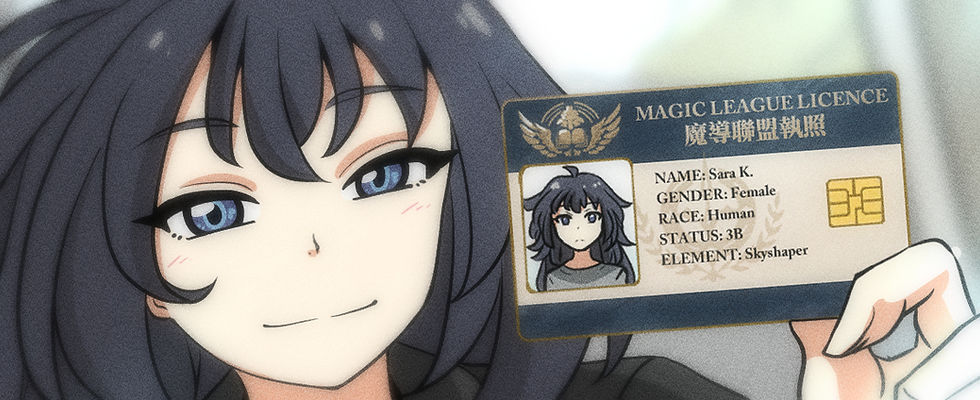
Magic License System
魔法執照系統
As magic became increasingly widespread and dangerous throughout history, the Magic League established a standardized licensing system to regulate its use and promote responsible magical practice. Supported by the Mythic Unity Foundation, which advocated for greater oversight of magical activities and research, the system was gradually adopted across much of the world and remains the foundation of modern magical regulation today.
While basic magic ability awakening is relatively common in the magic field, obtaining advanced ability demands years of training and discipline. Licensed users are expected to demonstrate both competence and control before being permitted to use magic professionally.
Although powerful magic users continue to command respect, advances in technology have reduced society's dependence on magic in many fields. As a result, fewer individuals dedicate their lives to pursuing mastery, with most licensed practitioners using magic as a support to their occupation.

Valrico the Crimson
血紅者瓦爾里科
A former human turned vampire and the leader of the Blood War. Deeply devoted to Dracula, Valrico viewed him as a visionary whose dream of a world ruled by vampires had been left unfinished. While Dracula believed that vampirism represented the next stage of mankind’s evolution, Valrico became convinced that humanity would never willingly embrace that future on its own.
Following Dracula’s death, Valrico launched a relentless campaign to spread vampirism across the world. Because becoming a True Blood Vampire required willing consent, he would first drive his victims to the brink of death before offering them a final choice. To Valrico, every new vampire was another step toward the future Dracula had envisioned.
Obsessed with avenging his fallen master, Valrico relentlessly pursued members of the Helsing bloodline, holding them responsible for Dracula's death while expanding his forces across the world. His eventual defeat brought an end to the Blood War and led to the establishment of the modern vampire regulations that continue to govern vampire society today.

The Reformation of Dusmore 德斯摩的改革
Following the defeat of Valrico during the Blood War, vampire society underwent significant reforms. While vampires had inhabited Dusmore long before the conflict, the war demonstrated the dangers of unchecked turning and expansionist ideology.
Under the leadership of the Great Elders, Dusmore was reorganized into a regulated vampire homeland. A series of international agreements established strict controls on the vampire population. Unauthorized turning was outlawed, with severe penalties imposed on violators. Only recognized Great Elders were permitted to create True Blood Vampires, while vampire-human hybrids were encouraged due to their finite lifespans and limited impact on population growth.
These reforms transformed Dusmore into the center of modern vampire society and established the legal framework that continues to govern vampires throughout the world today.

High Matron of Blood, Lady Lucilla
血之至高女監護者·露西拉
Lady Lucilla is the oldest known vampire and serves as the High Matron of Blood, ranking above Dusmore's Great Elders. Having lived since before the Second Great War, she is the only being still alive believed to have witnessed the burning of the Tree of Mana firsthand.
Unlike Dracula and many of her kin, Lucilla did not support the expansionist ambitions that would later lead to the Blood War. However, she also refused to oppose them directly, choosing instead to remain apart from the conflict while much of vampire society followed its own course.
Over the centuries, Lucilla became one of the architects of modern vampire society and the system of laws that governs it today. Her authority stems less from political power and more from age, reputation, and the fact that she has survived longer than nearly any other known individual in recorded history.
Despite this, historians often approach her accounts with caution. Many events she describes occurred thousands of years ago, and few, if any, living witnesses remain to confirm or challenge her testimony. As a result, scholars remain divided on how much of her version of history should be accepted as fact.
To her supporters, Lady Lucilla is a living link to the ancient world. To her critics, she is simply the last witness, and therefore the only one left to tell the story.

Thalos the Great
巨人英雄塔洛斯
Thalos was a giant warrior who lived during the Second Great War and is widely regarded as one of the greatest heroes in Tataran history. Unusually large even by giant standards, his immense size and strength became the subject of countless legends.
Unlike many heroes of the era, Thalos did not join the war during its early stages. Historical accounts suggest he became involved only after the conflict threatened to spread toward Giant territories. Rather than participating in the campaign against the Demon Lord directly, Thalos spent much of the war defending what is now known as Valor Spring, preventing enemy forces from advancing further.
Following the war, he returned to Tataros and lived peacefully for the remainder of his life. Despite his extraordinary stature, his unusual physique is believed to have shortened his lifespan, and he died younger than many giants of his era.
Today, Thalos is remembered not for seeking glory, but for answering the call when it mattered most. His sword, Sky Breaker, remains embedded in Valor Spring, while his final resting place lies beneath Mount Thalos in Tataros.

Giant and Orc Conflict
巨人與半獸人的衝突
The Giants of Tataros and the Orcs of Orgogh shared a long-standing conflict. Many Orcs viewed the Giants as the ultimate test of strength and frequently challenged or raided their eastern neighbors.
Despite their smaller size, the Orcs proved capable opponents, while the Giants relied on their immense strength to hold the border. Neither side gained a decisive advantage, leading to the establishment of a permanent border and a policy of mutual non-interference.
Today, relations are generally peaceful. Orgogh’s gladiatorial sports and trial-by-combat traditions provide an outlet for its warrior culture, allowing both nations to coexist without frequent conflict.

The Humbling of the Giants
巨人族的挫敗
Long before the Great Wars, the Giants of Tataros were a far more aggressive civilization. Confident in their immense size and strength, early Giant rulers believed themselves naturally superior to smaller peoples and sought to expand beyond their homeland.
Their ambitions ended almost as soon as they began. According to Giant records, their forces encountered what they believed to be an ordinary shepherd. When confronted, however, the shepherd revealed himself to be an extremely powerful mage and overwhelmingly defeated their forces before most of the world even realized it had begun. The battle took place within what is now the Jurrasica Preserve, where the destruction is believed to have permanently altered parts of the landscape. Despite possessing the power to destroy them, the shepherd chose to spare the Giants, leaving them humbled and deeply ashamed of their arrogance. Curiously, no records outside Tataros mention this individual, leaving his identity and very existence covered in mystery.
The defeat transformed Giant society. Tataros abandoned its ambitions of conquest, and over generations, the lessons of humility, restraint, self-mastery, and contentment eventually developed into the Way of Tranquility.

The Thousand-Year Conflict Between Tiris and Auris
提里斯與奧里斯的千年衝突
For centuries, the Goblin Kingdom of Auris and the Drakeling Kingdom of Tiris were bitter enemies. Their conflict was fueled not only by the Goblins’ alliance with the Demon Lord during the Second Great War, but also by the radically different values of their societies.
Traditional Goblin culture is heavily matriarchal, with women occupying the vast majority of positions of authority. Men are generally expected to work, fight, and serve their families and communities. To outsiders, this often appears unequal, but within traditional Goblin society it is widely accepted as the natural order. Goblin men take pride in supporting their queens, families, and communities, believing that women are meant to lead and that it is a man's duty to provide for and protect them.
Although the Demon Lord was defeated in the Second Great War, the Kingdom of Auris did not abandon many of the ideals it had embraced during the conflict. Under the authority of its Queen, the kingdom continued to view its matriarchal society as the proper model for civilization and sought to promote its cultural values beyond its borders. Traditional Tiris society held the opposite view, believing leadership and political authority should belong to men. These competing worldviews created deep hostility between the two kingdoms, with each believing its own social order represented the proper path for society.
At various points in history, factions within Tiris openly advocated for the complete destruction of Auris. The Goblins survived largely through Boldohr's support, whose leaders viewed the conflict as increasingly unjust and helped protect the kingdom from external threats.

The Reconciliation of Tiris and Auris
提里斯與奧里斯的歷史性和解
In recent years, the governments of Tiris and Auris have worked to normalize relations after centuries of conflict. The effort has coincided with broader social changes in both nations and a series of agreements aimed at ending their long-standing ideological conflict.
As part of the peace process, Auris formally renounced the expansionist ideals inherited from Lilratha’s era. The promotion of Lilraran ideology beyond its borders was prohibited, and organizations advocating the spread of a unified matriarchal state were outlawed under the agreement. In return, Tiris recognized Auris’s sovereignty and agreed to end its long-standing policy of seeking to contain or eliminate the Goblin Kingdom.
In Tiris, reforms promoting greater political opportunities for women have faced resistance from traditionalists. One particularly divisive moment came when Zeraya Voss was appointed Royal Captain and personal bodyguard to the ruler, a role for which she was fully and unquestionably qualified.
Meanwhile, Auris has gradually softened some of its historic attitudes toward men. While Goblin society remains strongly matriarchal, many of the more extreme customs of previous centuries have steadily declined. Centuries of interaction with Boldohr played a significant role in this shift, with the dwarves continuing to support Auris while encouraging more moderate social policies.
Although these reforms remain controversial in both nations, they have significantly improved relations between Tiris and Auris, ending one of the world’s longest-standing ideological conflicts. As trust gradually returned, most nations began welcoming Goblin visitors and tourists, provided they met the same immigration and security requirements as any other traveler. While prejudice has not disappeared entirely, Goblins are increasingly viewed as citizens of Auris rather than representatives of a bygone ideology.
Goblin Citizenship Restrictions
哥布林公民權限制
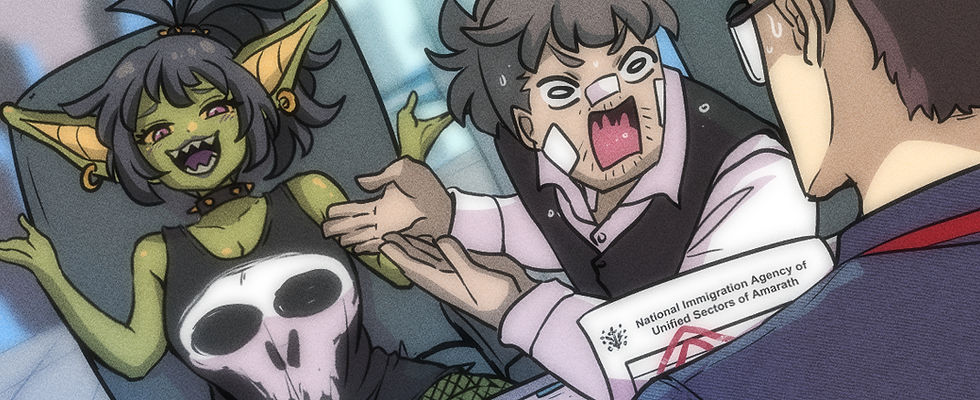
Goblins possess a unique biological trait: regardless of the race of the other parent, the child will always be born a Goblin.
Combined with centuries of political tensions and cultural differences, this led "every" nation to adopt strict citizenship policies regarding Goblins. While Goblins are generally free to travel internationally, permanent residency and citizenship remain heavily restricted throughout the world.
As a result, Auris remains the primary homeland of Goblin society, and many Goblins who marry foreigners eventually relocate there permanently.

The Neglect of Isles Lagoon
潟湖島的孤立與忽視
Throughout much of recorded history, Isles Lagoon remained politically isolated and largely uninvolved in the world's major conflicts and alliances. While this allowed the nation to avoid many wars, it also meant that few nations paid attention to its struggles.
For generations, ocean currents carried waste, debris, and pollution from across the world into the waters surrounding the islands. Because the pollution originated from numerous countries and continents, responsibility was often difficult to assign, leaving the problem largely unaddressed. As a result, Isles Lagoon bore the consequences of pollution it had little role in creating.
Conditions improved only in recent decades following large-scale cleanup efforts, most notably those led by Hearton Corp.

The Merfolk Pirate Era
海族海盜時代
For centuries, the water territories of Isles Lagoon were home to numerous Merfolk pirate groups that preyed upon passing vessels. While attacks rarely threatened Isles Lagoon itself, merchant ships from other nations frequently suffered losses.
The government of Isles Lagoon generally took little interest in suppressing these activities, viewing disputes involving surface vessels as outside its responsibility. This attitude contributed to growing frustration among many land nations and further reinforced Isles Lagoon's political isolation.
The pirate problem persisted for generations before declining in recent decades. As part of broader agreements between Isles Lagoon and Hearton Corp, anti-piracy operations and regulations ended pirate activity throughout the region. Today, pirate fleets are largely considered a thing of the past, with many former pirate families transitioning into legitimate trades such as fishing, tourism, and restaurant ownership.

The Rulers of Isles Lagoon
潟湖島的統治者
For generations, Isles Lagoon has been governed by its royal family, which serves as the kingdom's highest authority both above and below the waves. The current royal household consists of the King, Queen, and their seven royal children, each entrusted with responsibilities that help govern different aspects of Merfolk society.
-
King of Isles Lagoon
The King serves as the highest authority of Isles Lagoon and oversees the kingdom from Azure Realm, the underwater royal capital. Though respected throughout the nation, he is rarely seen by surface dwellers and seldom participates directly in foreign affairs. Most visitors to Isles Lagoon spend their entire stay without ever encountering him.
-
Queen of Isles Lagoon
The Queen remains one of the least visible members of the royal family. Residing within Azure Realm, she rarely appears before foreigners and is rarely involved in internal royal affairs. Despite her limited public presence, she remains a respected figure throughout the kingdom.
-
Princess Coral
Princess Coral serves as the kingdom’s representative to the surface world. From Blossom Bay, she oversees diplomacy, trade, tourism, and foreign relations. Through her efforts, Isles Lagoon established limited cooperation with outside nations, including its partnership with Hearton Corp.
-
Prince Nerion
Prince Nerion oversees the defense of Isles Lagoon’s waters. While each royal sibling maintains their own retainers and personal forces, Nerion is primarily responsible for coordinating the kingdom's major marine patrols and external defenses. Monitoring the Veiled Deep and responding to threats posed by dangerous sea creatures and other hazards beyond the kingdom's borders.
-
Princess Nerissa
Princess Nerissa is responsible for environmental preservation throughout the kingdom. Her duties include maintaining coral reefs, marine forests, and the natural systems that sustain Isles Lagoon’s ecosystem.
-
Prince Caspian
Prince Caspian oversees trade, fisheries, and resource management. He manages commercial activities throughout the kingdom and supervises the export of valuable resources such as Sea Metal.
-
Princess Marina
Princess Marina oversees the kingdom's internal administration and legal affairs. She implements laws, oversees government institutions, and works closely with local officials and nobles to ensure the smooth operation of Isles Lagoon's domestic affairs.
-
Prince Delmar
Prince Delmar is responsible for many of Isles Lagoon’s distant underwater communities. His role focuses on maintaining connections between remote settlements and ensuring that resources and services reach all corners of the kingdom.
-
Princess Selene
Princess Selene serves as the guardian of Merfolk culture and tradition. She oversees historical preservation efforts, cultural institutions, and religious ceremonies dedicated to the guardian deities of the sea.

The Isolation of Sylvenor
希諾爾的隱世之路
Following the defeat of the Demon Lord Lilratha and the burning of the Tree of Mana, a significant portion of the Elven population chose to separate themselves from the emerging nation of Amarath. Many viewed the destruction of the Tree as an unforgivable act, believing it had severed the world’s connection to the gods and permanently diminished Elven lifespans.
Tensions were further heightened by Amarath’s acceptance of former enemies. While Amarath promoted unity and cooperation between races, many Elves believed such ideals came at the cost of tradition, identity, and accountability.
Rather than remain within a society they no longer recognized, these Elves departed Enhnore and established the secret realm of Sylvenor. Hidden deep within the forests, the nation developed a culture centered on preserving ancient Elven customs, protecting nature, and maintaining distance from outside influence.
Over time, Sylvenor also laid claim to the Savana Rainforest, arguing that the High Elves had transformed the region into the thriving ecosystem seen today over centuries. While Sylvenor considers the rainforest an integral part of its national heritage, the claim remains a subject of occasional dispute among historians and neighboring nations.
Following the Iron Divide, Sylvenor allowed a small number of Dryad communities to settle in the Savana Rainforest. Regarded as fellow guardians of nature, the Dryads were welcomed for their ability to nurture and preserve the forest's ecosystem. However, settlement within Sylvenor itself remained heavily restricted, reflecting the nation's long-standing isolationist policies.

The Rise of Kagehon
影國的崛起
For much of its history, Kagehon remained an isolated island nation, developing its own customs, martial traditions, and systems of government largely independent of the mainland. This isolation persisted until the aftermath of the Second Great War, when the weakening of magic was noticed even within the island.
Seeking answers, Kagehon dispatched some of its most skilled warriors, scholars, and magic users to investigate the changes occurring beyond their shores. Their arrival surprised many mainland nations, which knew little of the distant island kingdom. Early contact was not always peaceful, as cultural differences, territorial misunderstandings, and mutual suspicion occasionally led to conflict.
Over time, these encounters gave way to trade, diplomacy, and cooperation, allowing Kagehon to gradually establish relations with the outside world. Though the nation would eventually become one of the world’s leading industrial powers, it continues to preserve many traditions that originated during its long centuries of isolation.

Kazakiri Clan
風斬一族
The Kazakiri Clan traces its origins back centuries to the early days of Kagehon, when skilled swordsmen defended the island from pirates, raiders, and rival warlords. Hidden within the valleys of Kuroyama, they developed the Kazakiri Style, a martial tradition combining swordsmanship, stealth, and wind magic. Renowned for their speed and precision, the style remains one of the most famous schools of wind-based combat in the world.
Throughout history, the Kazakiri maintained close ties to the Shogun. While the government officially denies any formal connection, the clan is widely believed to carry out missions too sensitive or dangerous for conventional forces. As a result, their existence is often described as an open secret within Kagehon.
Beyond Kagehon, the Kazakiri are known throughout the underworld as elite mercenaries willing to undertake nearly any mission for the right price. Within the nation, however, they are generally viewed as loyal servants of Kagehon whose primary allegiance lies with the Shogun and the country’s security. Though their methods remain controversial, many citizens regard the clan as a necessary existence.