Race and Species Category
There are a variety of races and species in this world; this page shows the general categories.

Human
Humans are the most widespread and adaptable race, found in almost every region of the world. They are known for their diversity, both in culture and for their ability to form mixed lineages with other races.
On the continent of Amarath, humans usually have fair to medium skin tones, while those from Tiris tend to have darker complexions. In the far north, many humans have distinctive white hair, a trait shaped by generations in icy climates. Some families carry a “Tataran” name, hinting at distant giant ancestry, though they look like regular humans. There are also islanders who, after generations of isolation, have developed their own unique customs and traits.

Tiefling
Tieflings are a common presence throughout the continent of Amarath, recognized by their horns. Some Tieflings have skin tones similar to humans and are referred to as Palehorns, while others show striking shades of red, purple, or gray and are referred to as Shadehorns.
Once inhabitants of the now-forsaken continent, they were welcomed into Amarath after their homeland’s devastation.
Among the Tatarans, Tieflings are categorized as "Mozu," a term many Tieflings reject due to its associations with a dark history; most notably, the era of the Demon Lord, a Tiefling who nearly enslaved the world.

Elf
Elves, even without the tree of mana, remain a long-lived race. In Enhnore, a region within Amarath, the elven community includes Lunari, Duskari, light and dark-skinned elves, as well as those of mixed human and elven heritage.
While undetectable to non-elves, elves can sense and recognize half-elves among them. There is a clear distinction between elves and half-elves, primarily due to their different lifespans.
The Duskari, originally from a distant continent, lost during the Scorching War, have been welcomed as full members of Enhnore.
Another group, the self-proclaimed High Elves, rejected Enhnore’s unity to found their own nation, Sylvenor.

Beastkin
Beastkin are people with animal traits such as ears, tails, or fur. They can be found on most continents and are especially common throughout Amarath, but their place of origin is Minkwood, a region within Amarath.
Due to their primal heritage, they possess sharper senses, particularly hearing and smell, than most other races.
There are two main groups of Beastkin, the Furfolk and Eartail. Furfolk have more animal-like bodies covered in fur, while Eartail appear mostly human except for their animal ears, tails, and occasionally, horns.

Halfling
Halflings are a small-statured folk known for their love of underground homes, whether carved into hills or deep within mountains.
The three main halfling groups are Dwarves, who are renowned for their tireless craftsmanship and are mostly found in Boldohr; Duergars, adapted to heavy industry with their distinctive grey skin, make their home in Varethis and often resent being grouped with other halflings; and Fellit, easygoing and fond of festivals, food, music, and firearms, reside in Nimblehill, a region within Amarath.

Merfolk
Merfolk are aquatic humanoids, primarily found in the isolated nation of Isles Lagoon, and it is extremely rare to encounter a Merfolk outside its borders.
Mermaids and Mermen have human upper bodies with fish-like tails. Fishmen look mostly human but have fish-like skin and features, while Cecaelians are distinguished by their octopus-like tentacle traits.
Some held a deep grudge against landfolk for the pollution they brought to their nation. However, in recent times, these tensions have eased thanks to the efforts of Hearton Corp and a royal princess who helped bridge the divide.

Cyclops
In ancient times, some cyclops were huge and monstrous. Though cyclops have changed over the ages, nowadays they are so closely related to humans that they are often considered simply one-eyed humans.
While cyclops vary widely in skin tone due to generations of intermarriage with humans, they do not concern themselves with skin color; for them, identity is defined by their single eye. Most cyclops communities are concentrated in Dustfall, a region within Amarath that serves as their main homeland.

Orc
Most Orcs live in Orgogh, but a small number have settled in Amarath and other continents. Among themselves, they don’t divide by subgroups; there is only one identity: Orc.
They are known for their fierce warrior heritage and passion for combat. While most Orcs still embrace these traditions through gladiator-style arenas and a trial-by-combat justice system, some are less drawn to the culture and often express their energy and strength in non-violent ways, such as bodybuilding. However, even these Orcs may revert to their warrior nature when provoked.
Many orcs are not fond of goblins, partly because their similar green skin often leads to confusing the two. They take pride in their strength and traditions, and being mistaken for goblins is seen as an insult by most.

Goblin
Goblins are a race in which women (Gobara) hold all positions of power and authority, while male (Gobo) goblins are relegated to hard labor and second-class status; even female goblin affection is often expressed through teasing or harshness, a dynamic that can confuse outsiders.
Goblins are one of the most strictly regulated groups, due to their genetics; any race partnered with a goblin will always have a goblin child. As a result, while goblins may visit other nations as tourists, they are never granted citizenship, even through marriage. Any non-goblin who marries a goblin loses their citizenship and must move to Auris, the goblin kingdom.

Vampire
Since the Blood War, vampires have become a carefully regulated race with unpredictable abilities, which is why they are also categorized as “Mozu” by the Tatarans. Turning others into vampires is forbidden; only the highest-ranking elders have the authority to approve of creating new True Blood Vampires.
There are three main types of vampires. Daywalkers can move in sunlight with no ill effects and live and die as mortals. Dawnwalkers are also hybrids, but possess a stronger vampiric side; they experience pain and discomfort in full sunlight, like a severe sunburn, but are not killed by it. Unlike Daywalkers, Dawnwalkers have the ability to turn others into Vampires. Sunlight is lethal to True Blood Vampires, except for the High Matron of Blood, the only True Blood Vampire who can withstand the sun.
Their main homeland is Dusmore, a cold nation governed by the Great Elders, where daylight is brief.

Giant
Giants are an ancient race of towering beings, with adults so large that the average human only reaches their knees, making them about four to five times taller than most people.
There are two groups: the true giants, called Tataran, and the Tatarin, who are humans descended from giants and bear the Tataran family name.
Most giants live in Tataros, their homeland designed for their immense size. While Tatarin are welcome there, many choose to leave, since daily life in a land built for giants can be challenging for those of human-sized.
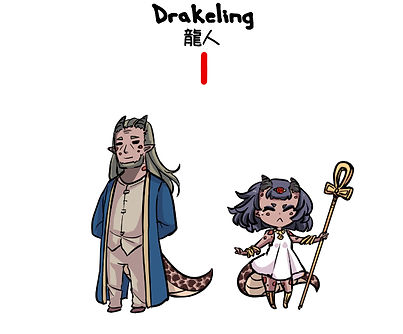
Drakeling
Drakelings are a people native to Tiris, the desert continent, known for their dark skin tones, small horns, reptilian or dragon-like tails, and patches of scales on parts of their bodies.
They are well adapted to hot climates and tend to dislike cold weather. Historically, Drakelings have had a strong dislike for goblins due to cultural and historical conflicts; while this animosity has softened over time, it still lingers among some Drakelings.
Some believe Drakelings may be closely related to Tieflings who settled in Tiris long ago, while others consider them the descendants of ancient dragons. Their true origins remain a subject of debate.

Bot
Bots, or androids, are a new type of artificial being created to closely resemble and behave like humans. Developed by Professor Shing of Heartorn Corp., there are two main types for now: the Alpha units, which are advanced humanoid androids indistinguishable from humans but equipped with exceptional combat abilities, strength, agility, and high adaptability that match those of an elite Rank-A magic user.
The second type is mass-produced Pacifica units, all sharing the same appearance and network; each may seem to have its own personality and independence, yet every single one is centrally controlled and obeys a single collective main core AI. Though individually weaker than their advanced counterparts, they remain stronger than an average human and function with full shared knowledge and coordination.
The third type, the Domestic unit, which even other companies have attempted with their own androids or AI, is more mechanical and lacks lifelike qualities, making it feel more like a tool than a true member of society.
As this category of artificial beings is relatively new, it has raised as much concern as optimism among the public.

Lamia
Lamia are people with human upper bodies and long, snake tails instead of legs, with the majority of their population being female due to the rarity of male Lamia. As a result, most Lamia women take human men as partners to reproduce, a pairing that is very common in Lamia society.
By contrast, a female Lamia pairing with a male Lamia is considered a status symbol, typically seen among the wealthy, royalty, or those in high political positions. It’s regarded much like dating someone from the top 1% in human society.
As members of the broader non-bipedal community, most Lamia live in Miradia, a land the Tatarans refer to as the “Mozu continent.” It’s rare to see Lamia elsewhere, as most of the world isn’t built for those without legs, and the few who do leave Miradia face daily challenges adapting to other societies.

Centaur
Centaurs are easily recognized by their human upper bodies and equine lower halves. Two main terms have emerged among centaurs: the Freehoof of Varkathis, who lead a nomadic, tradition-focused life and deeply value freedom and their connection to the land; and the Cityhoof of Amarath, who have adapted to modern life.
Cityhoofs are most commonly found in Wheatmere, working as farmers or competing as professional racers across the nation, with racing now a major gambling sport; Freehoofs often look down on Cityhoofs for commercializing a tradition they hold sacred.
While Cityhoofs are well-suited to a modern lifestyle, their size means they are mostly limited to areas with large open spaces and custom-made furniture and clothing. Although both centaur groups share a common ancestry, their values and ways of life have become increasingly distinct. But, regardless of whether a centaur is a Cityhoof or a Freehoof, allowing someone to ride represents a close bond, and doing so without explicit permission is likely to provoke anger and deep offense.

Chimeran
Chimerans are a rare race from Ilanard, known for possessing bodies combined with multiple animal traits that should not naturally exist. According to Ilanardi folklore, the first Chimerans were created by river spirits during an ancient flood, merging fragments of living creatures together to preserve life.While most scholars dismiss this as myth, no proper explanation for their existence has ever been discovered.
Chimerans possess the unusual ability to split parts of their bodies into smaller, independent creatures that behave more like siblings or companions than like extensions of the body itself. Some may not have Chimeran traits at first but develop them later, or even skip generations, making their bloodlines difficult to trace.
Because of their unnatural appearance, Chimerans are often viewed worldwide with both fascination and unease. In Ilanard, however, they are commonly seen as symbols of survival, adaptation, and the sacred rivers themselves.

Harpy
Harpies are a winged race that commonly reside within coastal regions and high mountain settlements. While Harpies can be found in some nations, the largest populations are in Zephyros, a mountainous region where flight remains central to daily life, and the coastal cities of Luminara in Amarath.
Unlike most races, all Harpies are female. To reproduce, a Harpy must find a male mate from another race, with the exception of Goblins; the children always inherit the Harpy race. Traditionally, Harpy communities were structured around mothers and extended family groups, and fathers were generally not expected to take part in raising their children. In modern times, however, full households have become increasingly common, particularly among Shorewing communities.
Two major cultural groups have emerged among Harpies. Highwings live among the mountains of Zephyros, while Shorewings are more commonly found in coastal towns and port cities.

Dryad
Dryads are a nature-bound race recognized by their greenish skin, leaf-like hair, and deep connection to the natural world. Most reside within the forests of Phuipuvia, with smaller communities found in Yuidasriln near the border of Sylvenor, where they live in harmony with nature and reject industrialization in favor of a spiritual lifestyle.
Unlike most races, all Dryads are female and reproduce through a process known as the Blooming. During this period, a mature Dryad may choose to nurture a Heartseed that forms within her body. To carry the child to term, she must spend months resting within sacred waters while being cared for by her community before eventually giving birth. Although the choice is hers, many Dryads view motherhood as one of nature's most sacred callings, and those who never undergo a Blooming are often met with quiet disapproval.
Dryads are fiercely protective of the natural world and remain distrustful of the Duergars of Varethis, whose expansion once claimed much of their land.

Arachne
Arachne are a race recognized for their human upper bodies and spider-like lower halves. Due to their intimidating appearance, Arachne have historically faced prejudice in many parts of the world, which has made Miradia the only nation they truly consider a homeland.
Arachne are known for their solitary nature and preference for isolation, making lifelong partnerships uncommon. Female Arachne traditionally takes the active role in seeking mates, leading Miradia to enact strict laws against the unlawful confinement of potential partners.
Many Arachne have embraced modern technology and online communities, further reinforcing their already socially isolated lifestyles; Arachne pregnancies remain uncommon even among successful pairings, contributing to their steadily declining population.

Ghost
Ghosts are souls that remain after death, though what normally happens afterward remains uncertain and differs between religious beliefs. Most eventually leave the mortal world, while some continue to linger.
Soul Eaters are among the few who can clearly see lingering spirits. Lithana, a soul eater, informally calls those who have wandered for so long that they forget their identity “Marshmallows,” small white spirits that drift around aimlessly, seemingly carefree and content.
Their opposite, “Gloomies,” are souls overwhelmed by hatred, grief, or bitterness until they also lose who they once were, becoming dark, oozing spirits trapped in endless despair. Both names are simply terms Lithana created from her observations, rather than official classifications.

Ogre
Ogres are Orcs who have embraced the belief that consuming other people grants them greater strength. While cases of cannibalism have occurred among other races, the practice and transformation among Orcs is distinct enough that those who embrace it are classified as Ogres. Orcs refuse to recognize them as their own, viewing Ogres as dishonorable creatures who abandoned discipline, self-control, and mind in pursuit of easy power.
Even modern Orcs can become Ogres, leading to persistent rumors of an underworld within Orgogh that secretly provides such services. Whether these networks truly exist remains disputed, but the practice itself is strictly illegal. Ogres have no recognized society or homeland and are actively hunted by Orc authorities and the MUF.
Those captured by Orgogh are condemned to the arena, where, unlike ordinary competitors, they fight under a permanent sentence with no possibility of earning their freedom.

Dullahan
Dullahans are an extremely rare being created when a person is decapitated, but immense Mana causes their soul to remain bound to both their head and body. Once more common when the Tree of Mana still stood, only a handful have emerged in the modern era.
Tiris is the only nation that still practices execution by beheading. If an execution produces a Dullahan, it is regarded as a sign from the Sun Father, and the condemned is spared. Most eventually relocate to Miradia, where they are more openly accepted.
Dullahans retain the natural lifespan and aging of their original race, and are neither immortal nor truly undead.

Slime
Slimes are mysterious beings that once formed naturally from the immense Mana produced by the Tree of Mana, condensed into a single core. Since the tree’s destruction, no confirmed natural Slime has ever appeared.
Slimes have no sex or humanoid form, though most take the appearance of women after learning that such forms are generally more approachable. They do not age or reproduce, and only a small number of surviving Slimes can still be found in Miradia.
Slimes are classified as intelligent beings rather than legal persons. While they do not have the same rights as recognized races, Miradia grants them special protection because of their extremely small population. Officials nevertheless warn that Slimes can still be dangerous, and that the government offers no compensation for injuries or body parts lost through voluntary contact with one.
Slimes are considered an endangered species, though artificial Slimes rumored can be created through a highly complicated magical process, most associated with Isvaria.

Succubus
Soon